
Nigeria’s pharmaceutical landscape is undergoing a significant transformation. Driven by stronger regulatory standards and deliberate policies to boost domestic production, the industry is moving toward greater self-reliance, improved medicine quality, and stronger public confidence in pharmaceutical products. At the heart of this shift are two interconnected developments: the implementation of bioequivalence (BE) requirements for generic medicines and the expansion of local pharmaceutical manufacturing.
For local manufacturers, these developments present both opportunities and responsibilities. Producing medicines domestically is an important step toward improving access and strengthening medicine security, but sustainable growth also depends on scientific evidence, regulatory compliance, and consistent quality standards.
Contract Research Organizations (CROs) play a critical role in this process. By supporting clinical research, generating reliable scientific data, and strengthening research capacity, CROs help pharmaceutical companies navigate regulatory requirements and contribute to the development of a more resilient healthcare ecosystem.
At Xcene Research, our work in clinical research across Sub-Saharan Africa reflects the importance of building this ecosystem through scientific collaboration, research excellence, and capacity development. Initiatives such as the Sickle Cell Disease African Scientific Symposium (SCDASS) further demonstrate the value of bringing researchers, clinicians, industry stakeholders, and policymakers together to advance drug development and improve health outcomes across the continent.
Understanding Bioequivalence Requirements in Nigeria
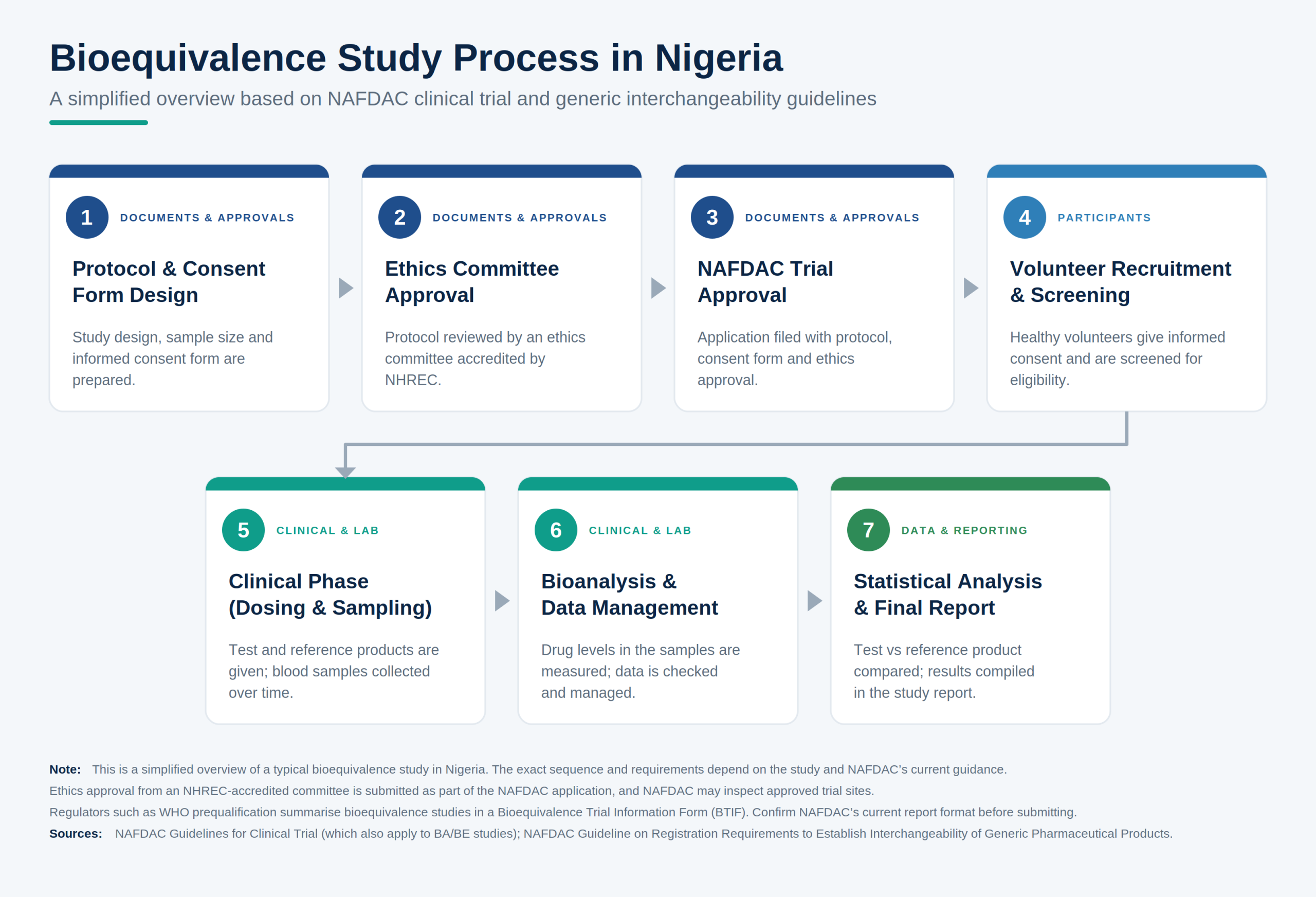
Bioequivalence is the scientific demonstration that a generic medicine delivers the same active pharmaceutical ingredient into the bloodstream at a comparable rate and to a comparable extent as an appropriate reference product. When bioequivalence is established in accordance with applicable regulatory standards, it provides evidence supporting the therapeutic equivalence of the generic medicine.
In May 2025, the National Agency for Food and Drug Administration and Control (NAFDAC) issued its Guidelines on the Investigation of Bioequivalence 2025 (DER-GDL-009-01), aligned with the International Council for Harmonisation (ICH) M13 framework. The guidelines establish expectations for the design, conduct, analysis, and evaluation of bioequivalence studies for immediate-release solid oral dosage forms with systemic action.
A typical study design is a randomised, two-period, two-sequence, single-dose crossover study involving healthy volunteers, where scientifically and ethically appropriate. Requirements address sampling schedules, washout periods, pharmacokinetic assessments, statistical analysis, and data integrity.
For conventional bioequivalence assessments, the commonly applied acceptance range for the 90% confidence intervals of the test-to-reference geometric mean ratios for area under the concentration-time curve (AUC) and maximum plasma concentration (Cmax) is 80.00%–125.00%, subject to the applicable product-specific requirements and regulatory guidance.
Implementation of the requirements is being phased, with priority given to selected essential medicines, including antimalarials, antibiotics, and products for neglected tropical diseases. Manufacturers must follow the applicable submission timelines for new registrations, renewals, and locally manufactured products.
Protocols must be submitted to and authorized by NAFDAC before study initiation, and final reports must follow the prescribed Bioequivalence Trial Information Form (BTIF) requirements. Studies must adhere to applicable Good Clinical Practice (GCP) standards, while the bioanalytical component must meet the relevant quality and laboratory requirements.
NAFDAC has also outlined qualification and compliance expectations for CROs conducting bioequivalence studies. These include appropriate organizational and investigator qualifications, facility readiness, regulatory authorization, and ongoing compliance oversight.
These measures are intended to strengthen the reliability of bioequivalence data, support effective regulatory decision-making, and improve the quality of medicines available to Nigerian patients.
Ultimately, these requirements serve a broader public health purpose: reducing the risk of ineffective or substandard medicines, improving confidence among healthcare professionals and patients, and aligning Nigeria’s pharmaceutical sector with internationally recognized scientific and regulatory standards.
The Growth of Local Pharmaceutical Manufacturing
Alongside regulatory reform, Nigeria is pursuing policies designed to increase domestic pharmaceutical production and reduce dependence on imported medicines.
NAFDAC’s 5+5 policy and Ceiling List initiative have formed part of the country’s approach to encouraging local manufacturing capacity. These measures, alongside government incentives and investment in the healthcare value chain, are intended to make domestic production more competitive.
Recent industry reporting has highlighted a shift toward increased local production, growth in contract manufacturing arrangements, and renewed investment in pharmaceutical facilities. These developments suggest that Nigeria is strengthening its potential to meet more of its domestic medicine requirements through local manufacturing.
Supporting this ambition are government initiatives intended to reduce the cost of pharmaceutical production, including fiscal incentives for qualifying pharmaceutical machinery, equipment, and raw materials. The Presidential Initiative for Unlocking the Healthcare Value Chain (PVAC) has also advanced the broader ambition of increasing local production of essential medicines, with a target of 70% by 2030.
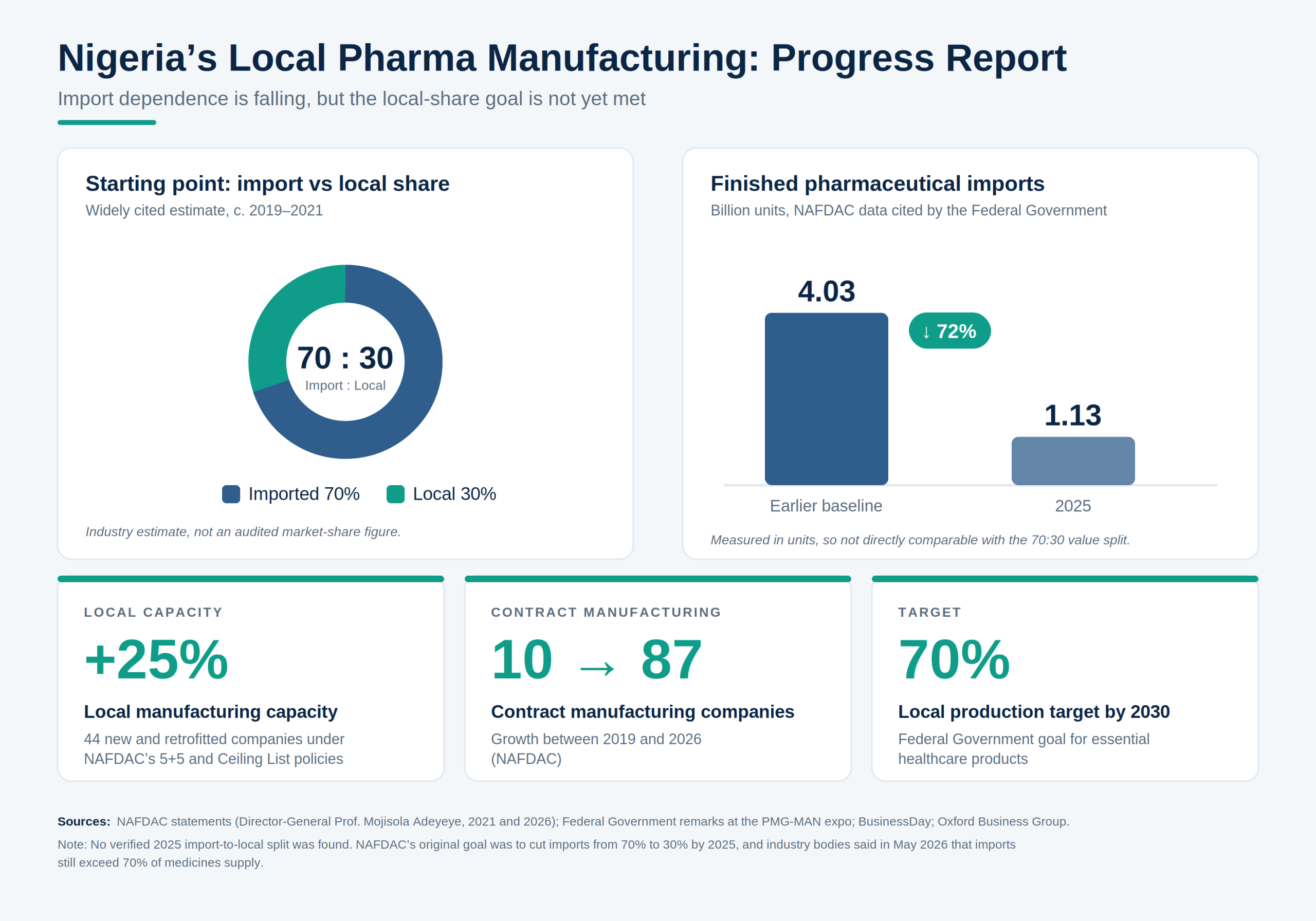
For Nigeria, the potential benefits are substantial:
- Improved medicine security and reduced exposure to international supply-chain disruptions.
- Reduced foreign-exchange pressure associated with pharmaceutical imports.
- Employment opportunities and the development of specialized technical skills.
- Increased investment in manufacturing infrastructure and research.
- Greater potential to serve regional markets under the African Continental Free Trade Area (AfCFTA).
However, expanding production capacity alone does not guarantee pharmaceutical quality. Manufacturers must also address dependence on imported active pharmaceutical ingredients (APIs), infrastructure limitations, regulatory compliance, and the need for robust quality management systems.
This is where clinical research expertise, bioanalytical capabilities, and effective quality assurance become particularly important.
Challenges at the Intersection of Bioequivalence and Local Manufacturing
As local manufacturers increase production, they must also demonstrate that their products meet the applicable regulatory requirements for quality, safety, and therapeutic equivalence.
For many companies, navigating these expectations presents several challenges.
- Technical complexity: Designing and conducting bioequivalence studies requires expertise in pharmacokinetics, protocol development, statistical analysis, bioanalytical methods, and regulatory documentation.
- Resource constraints: Some manufacturers may lack the in-house personnel, facilities, and specialized systems needed to manage every stage of a bioequivalence programme.
- Participant safety and ethics: Studies involving human participants require appropriate ethical review, informed consent, medical oversight, participant protection, and robust adverse-event management.
- Data quality and integrity: Reliable regulatory submissions depend on validated analytical methods, accurate documentation, traceable data, appropriate quality controls, and compliance with applicable standards.
- Cost and timelines: Manufacturers must balance the cost of regulatory compliance with the commercial pressures associated with product development, registration, and market entry.
- Sustainable compliance: Companies seeking to expand into international markets may need to strengthen their quality systems and demonstrate their readiness to meet additional regulatory and inspection requirements.
Without appropriate expertise and planning, these challenges can lead to study delays, avoidable amendments, additional costs, or regulatory deficiencies.
Qualified CROs like Xcene Research help address these challenges by providing specialized research expertise and supporting manufacturers in developing scientifically sound, well-documented, and appropriately controlled studies.
How CROs Support Compliance and Quality Assurance
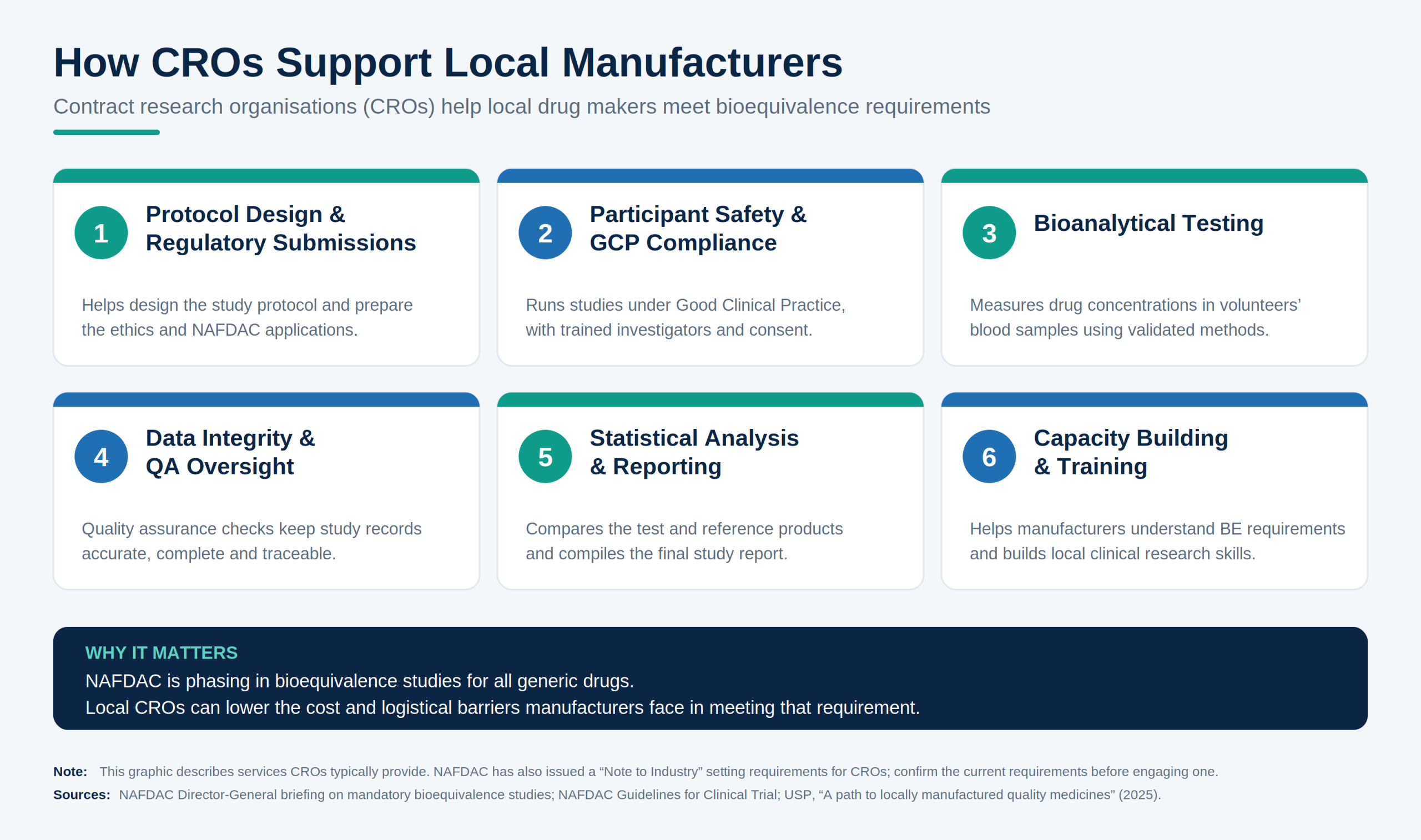
CROs are important partners in pharmaceutical development because they provide the scientific, operational, and quality expertise required to conduct research in accordance with applicable regulatory requirements.
Their contribution extends beyond individual studies to include the systems, skills, and processes needed to support sustainable research and product development.
1. Protocol Development and Regulatory Support
A well-designed study begins with a clear scientific question and a protocol that meets applicable regulatory requirements.
CROs support the development of study protocols, selection of appropriate study designs, sample-size justification, definition of pharmacokinetic endpoints, statistical planning, and preparation of supporting documentation.
They also assist with regulatory submissions and responses to regulatory queries, helping sponsors identify potential issues early and reduce avoidable delays.
For Nigerian manufacturers, working Xcene Research, a Nigerian CRO familiar with the local regulatory environment can help improve coordination between product development, regulatory affairs, and quality assurance teams.
2. Ethical Study Conduct and Participant Safety
The protection of research participants is fundamental to credible clinical research.
CROs help coordinate participant recruitment, eligibility screening, informed consent, medical assessments, study monitoring, and adverse-event reporting, as applicable to the study.
They also support compliance with approved protocols, ethical requirements, and applicable Good Clinical Practice standards.
These processes are essential because high-quality research must protect participants while producing reliable data that can withstand scientific and regulatory scrutiny.
At Xcene Research, our work across the clinical research landscape in Sub-Saharan Africa reflects the importance of building research processes around scientific rigor, responsible study conduct, and the protection of participants.
3. Bioanalytical Quality and Data Integrity
Bioequivalence studies depend on accurate measurement of drug concentrations in biological samples. The reliability of these measurements directly affects the pharmacokinetic analyses used to evaluate bioequivalence.
Appropriate bioanalytical systems therefore require validated methods, suitable equipment, qualified personnel, documented procedures, and effective quality controls.
Quality assurance activities, equipment calibration, audit trails, controlled documentation, and the investigation of deviations help maintain data integrity throughout the research process.
4. Statistical Analysis, Reporting, and Regulatory Submissions
Collecting study data is only one part of the process. The data must also be analyzed correctly and presented in a format that supports regulatory evaluation.
CROs provide or coordinate pharmacokinetic analysis, statistical evaluation, interpretation of results, preparation of study reports, and integration of supporting documentation into regulatory submissions.
For bioequivalence studies, this includes assessing the relevant pharmacokinetic parameters and applying the statistical criteria specified by the applicable guidelines.
Comprehensive documentation also helps sponsors respond to regulatory questions and maintain an appropriate record of study conduct and findings.
5. Quality Management and Capacity Development
Long-term regulatory compliance requires more than a successful individual study. It depends on the people, systems, and organizational culture responsible for maintaining quality.
CROs can support manufacturers through training, process reviews, quality-system assessments, documentation improvements, and preparation for regulatory inspections, within the scope of their expertise and engagement.
6. Risk Management and Continuous Improvement
Clinical research and pharmaceutical development involve scientific, operational, and regulatory risks.
CROs help sponsors identify potential risks, document protocol deviations, investigate root causes, implement corrective and preventive actions (CAPA), and maintain oversight of study quality.
This proactive approach supports continuous improvement and helps prevent recurring quality issues.
The value of an experienced CRO therefore extends beyond completing a study. It includes helping sponsors establish processes that support reliable research, regulatory compliance, and responsible product development.
Benefits for Manufacturers, Patients, and the Healthcare Ecosystem
When pharmaceutical manufacturers work with qualified research partners and invest in robust quality systems, the benefits extend beyond regulatory compliance.
For manufacturers, effective research planning and quality assurance can reduce avoidable delays, improve documentation, and support more predictable product development and registration processes.
For healthcare professionals, reliable evidence on the quality and therapeutic equivalence of medicines supports informed prescribing and treatment decisions.
For patients, stronger regulatory oversight and credible scientific evidence contribute to confidence in the medicines they use.
For the wider healthcare ecosystem, investment in research capacity, scientific collaboration, and quality systems can strengthen local expertise and support the development of a more resilient pharmaceutical sector.
The ultimate objective is to ensure that increased domestic production translates into access to medicines that meet the required standards of quality, safety, and efficacy.
Looking Ahead: Connecting Manufacturing Growth with Research Excellence
As Nigeria works toward its local pharmaceutical production ambitions and strengthens its regulatory framework, the demand for reliable clinical research, bioanalytical expertise, and quality assurance will continue to be important.
Manufacturers that plan for regulatory compliance early, invest in quality systems, and engage appropriately qualified research partners will be better positioned to navigate an increasingly demanding pharmaceutical environment.
Achieving these ambitions will require collaboration among regulators, manufacturers, CROs, research institutions, healthcare professionals, and policymakers.
At Xcene Research, we believe that advancing healthcare in Africa requires a sustained commitment to scientific rigor, ethical research, capacity development, and collaboration. Our clinical research work across Sub-Saharan Africa and our involvement in initiatives such as the Xcene Research Site alliance Network and Sickle Cell Disease African Scientific Symposium reflect the importance of strengthening the foundations on which credible research and responsible drug development depend.
As Nigeria’s pharmaceutical sector continues to evolve, the connection between local manufacturing, regulatory compliance, and clinical research will be essential to achieving sustainable progress.
Partner with Xcene Research
Are you exploring clinical research opportunities, seeking to strengthen your research capabilities, or looking to collaborate on initiatives that advance healthcare across Africa?
Connect with Xcene Research to discuss how our clinical research experience and commitment to scientific collaboration can contribute to your objectives.
Together, we can help build a stronger clinical research ecosystem that supports scientific advancement, strengthens healthcare delivery, and contributes to a more resilient pharmaceutical industry in Nigeria and across Africa.